
The Question That Changes Everything
“Everyone keeps telling us to ‘learn AI’ or ‘adapt to AI.’ But nobody’s explaining what that actually means for someone choosing a major in 3 months. How do we know what’s real advice and what’s just hype?”
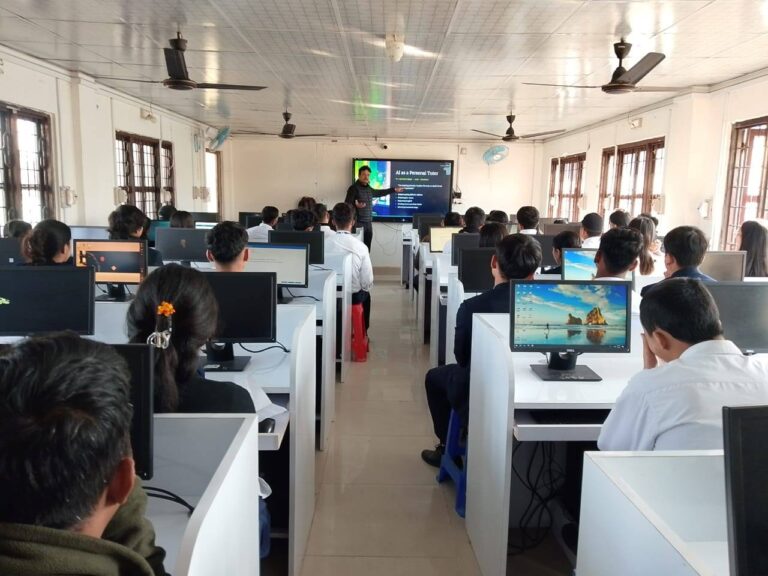
A Class 12 student asked us this on Day 1 of our AI Literacy Workshop in Birtamode, Jhapa.
She’s right to be skeptical.
Students across Nepal are being bombarded with conflicting messages: AI will take all the jobs (panic). AI will create new jobs (vague optimism). Learn to code (outdated). AI can’t replace human creativity (cope).
None of that helps a 17-year-old decide between engineering, medicine, business, or arts when they’re 90 days away from making that choice.
Why We’re Running This Workshop Series
We’re StudyPort—a platform built to help students make better education and career decisions. Our job is to close information gaps, especially when students are making life-changing choices based on incomplete or outdated information.
Right now, the biggest information gap in Nepal isn’t about entrance exam prep or scholarship opportunities. It’s about how to think about the future when AI is rewriting the job market in real-time.
Most education guidance in Nepal still operates on pre-AI assumptions:
- “Engineering is safe because we’ll always need engineers”
- “Become a doctor, it’s recession-proof”
- “Learn to code, tech jobs pay well”
These aren’t wrong. But they’re incomplete. They don’t account for a world where AI can write code, diagnose diseases from radiology scans, and analyze financial statements faster than humans.
Students don’t need motivation. They need clarity.
Why Eastern Nepal? Why Now?
Because the information asymmetry is highest outside Kathmandu
Students in regional Nepal are making the same high-stakes decisions as students in the capital—but with less access to current information, fewer mentors who understand AI, and limited exposure to what’s actually happening in the global job market.
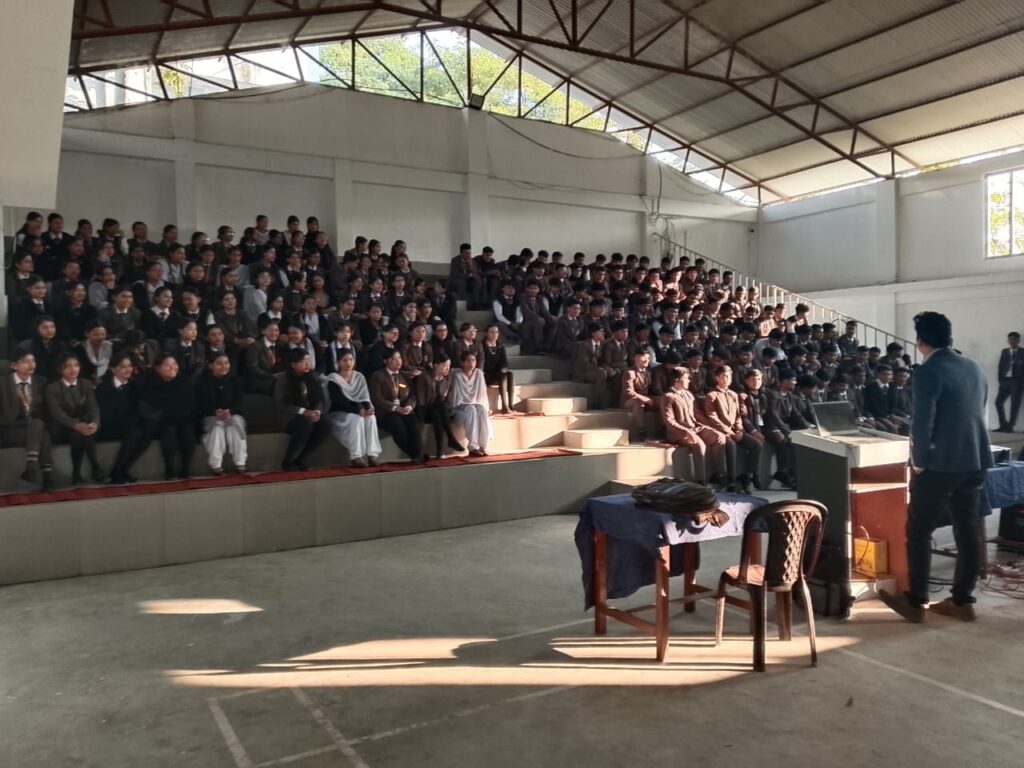
Over the next 10 days, we’re running AI literacy workshops across 9 institutions in eastern Nepal, reaching 1,500+ Class 12 students. Not in conference halls or tech meetups—in actual classrooms, with students who are about to choose their majors.
What We’re Teaching
This isn’t a coding bootcamp. We’re not teaching Python or prompt engineering.
We’re teaching students to think clearly about:
1. What AI actually is
Not magic. Not robots. Statistical models trained on data. Understanding this matters because it helps students see what AI is good at (pattern recognition, prediction) vs. what it struggles with (context, judgment, creativity in novel situations).
2. Which skills become MORE valuable when AI exists
Problem decomposition. Critical evaluation. Domain expertise. Communication. The ability to ask better questions. These are the skills that let you use AI as a tool instead of competing with it.
3. How to evaluate career advice in an AI-transformed economy
“AI-proof careers” is the wrong question. The right question is: “What problems am I solving, and how does AI change the way those problems get solved?”
4. How to make education decisions with incomplete information
Because let’s be honest—nobody knows exactly what the job market will look like in 2030. But we can teach students how to think about uncertainty, adaptability, and continuous learning.
What We’re Seeing So Far
The most surprising discovery from our first two days: some of these students are already using AI.
- A 17-year-old in Birtamode has been using Midjourney for 6 months—designing marketing posters for local businesses at ₹300 each. He taught himself from YouTube. His teacher didn’t know what Midjourney was.
- Multiple students are using ChatGPT to understand physics and math concepts that their textbooks don’t explain well.
- They’re creating reels, building side hustles, freelancing—with zero formal training in AI.
But here’s the problem: They’re using tools they don’t understand.
They don’t know how AI is trained. They don’t know why it sometimes gives wrong answers. They don’t know when to trust it and when to question it.
That gap—between usage and understanding—is what we’re here to close.
The Questions That Matter
Over the first two days, we’ve heard questions like:
- “If I learn to code now, will my skills be useless in 3 years?”
- “Can AI replace doctors?”
- “Should I still become a chartered accountant if AI can do accounting?”
- “If I can’t afford expensive coaching, how do I compete?”
These aren’t theoretical questions about AI ethics. These are survival questions from students trying to navigate a market that’s being rewritten while they’re standing in it.
This is why StudyPort exists. Not to give motivational speeches. To give students clarity when the adults around them are just as confused as they are.
What’s Next
We’re 2 days in. 7 schools left. 1,150 students to go.
We’ll be sharing updates from each day—the questions students ask, the gaps we discover, the moments where something clicks.
Because this isn’t just about delivering workshops. It’s about understanding what the next generation of Nepali students needs to navigate an AI-transformed world.
And then building that into StudyPort.
Follow along as we move deeper into eastern Nepal. The questions keep getting harder.
Good.